



Should You Replace Both Garage Door Springs When One Breaks?
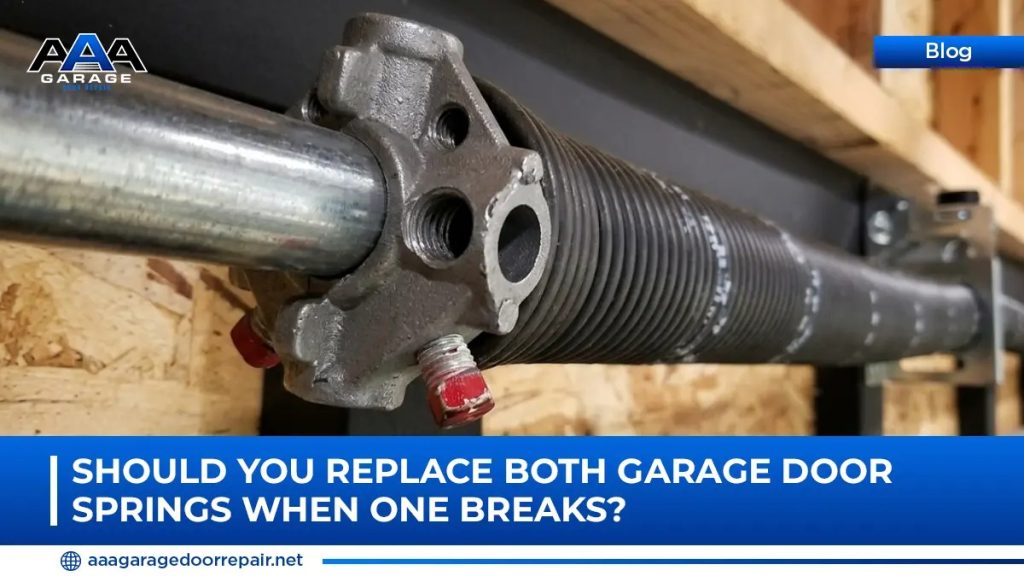
A broken garage door spring often creates one immediate question: if only one spring failed, why replace the other one too? For many two-spring residential systems, the answer comes down to matching wear, restoring balance, and reducing the chance that the second spring fails shortly after the first repair.
In Park Ridge and the greater Chicago area, garage doors may cycle several times a day through temperature swings that place repeated stress on the lifting system. When a spring snaps, the safest next step is to stop using the door and schedule professional spring replacement rather than asking the opener to lift a door that may no longer be properly counterbalanced.
Why Two-Spring Garage Doors Are Designed to Work as a Pair
On a typical torsion-spring setup, the springs share the work of counterbalancing the door. They are selected according to the door’s weight, height, drum configuration, and other hardware. When the springs are properly matched and tensioned, the door should lift evenly and the opener should only guide a door that is already balanced.
If one spring breaks, the surviving spring has usually completed roughly the same number of cycles. It may still look intact, but it has been exposed to the same daily use and age. Installing one new spring beside a much older spring can leave the system with components at very different points in their service life.
Why Replacing Only the Broken Spring Can Lead to Another Service Call
Replacing a single failed spring can sometimes get a door moving again, but the older spring may fail soon afterward. That can mean another stuck door, another appointment, and another period when the garage is difficult to use.
There is also a balance issue to consider. A new spring and a fatigued spring do not always behave identically. The technician still needs to set the system so both sides of the door lift evenly and the door remains controlled throughout its travel. A complete spring repair should include a balance check rather than ending as soon as the door moves.
What Industry Safety Guidance Says About Paired Springs
The Door & Access Systems Manufacturers Association advises homeowners with two-spring garage doors to replace both springs when one fails. Its garage door system safety guidance also emphasizes that springs are high-tension components and should be handled by trained technicians.
That recommendation is not about selling an unnecessary part. It reflects the reality that paired springs normally work through the same cycles together. Replacing them as a matched set gives the technician a more consistent starting point for restoring door balance.
Signs a Spring Has Broken or Is Losing Its Ability to Balance the Door
- A loud bang came from the garage even though nothing visibly fell.
- The door lifts only a few inches and then stops.
- A visible gap appears in the torsion spring above the door.
- The opener strains, hums, or sounds much louder than usual.
- The door feels extremely heavy when the opener is properly disconnected and the system is safe to test.
- One side of the door rises differently from the other.
- The door drops or will not stay controlled during movement.
Some of these symptoms can also come from cable, drum, roller, or opener problems. AAA’s garage door repair service is built around checking the full system so the repair addresses the actual failure instead of guessing from one symptom.
Why the Opener Should Not Be Used to “Help” a Broken Spring
A garage door opener is not designed to replace the lifting force of the springs. If a spring breaks, repeatedly pressing the remote can overload the opener, damage the trolley or drive components, and pull unevenly on a door that is already difficult to control.
If the door is stuck closed, leave it closed whenever possible. If it is stuck open or hanging unevenly, keep people and vehicles away from the opening and treat the condition as urgent. AAA provides 24/7 emergency garage door repair for situations where the door cannot safely wait.
What a Proper Spring Replacement Should Include
If you’re opting to replace your garage door spring, you might as well do it right by keeping in mind other components. Here’s a quick checklist for a more thorough repair work.
1. Confirm the spring type, size, and configuration needed for the specific door.
2. Inspect cables, drums, bearings, brackets, and the torsion shaft for related wear.
3. Install and tension the replacement spring or matched spring pair correctly.
4. Check the door balance with the opener disconnected.
5. Run the door through full cycles and verify smooth, even travel.
6. Re-check opener force, travel limits, and safety functions after the mechanical repair.
The goal is not simply to install a new coil. The goal is to restore a door that can move predictably without making the opener fight the weight of the system.
When to Call AAA Garage Door Repair
If you heard a snap, found a gap in the spring, or noticed that the door suddenly became too heavy to lift, stop cycling the opener. AAA Garage Door Repair serves Park Ridge, Chicago, and nearby Illinois communities and can inspect the spring system, cables, drums, rollers, and opener before recommending the repair.
Use the AAA Garage Door Repair contact page to request an estimate, or call the 24/7 line when the door is stuck, unsecured, or unsafe to move.
Final Takeaway
When one spring breaks on a two-spring garage door, replacing both is often the more reliable approach because both springs have usually accumulated similar wear. A matched pair makes it easier to restore even balance and reduces the likelihood of another near-term spring failure. Leave spring tension work to a trained technician and have the complete lifting system checked before the door returns to normal use.
Guide did not fix it?