



Why Your Garage Door Opens a Few Inches and Then Stops
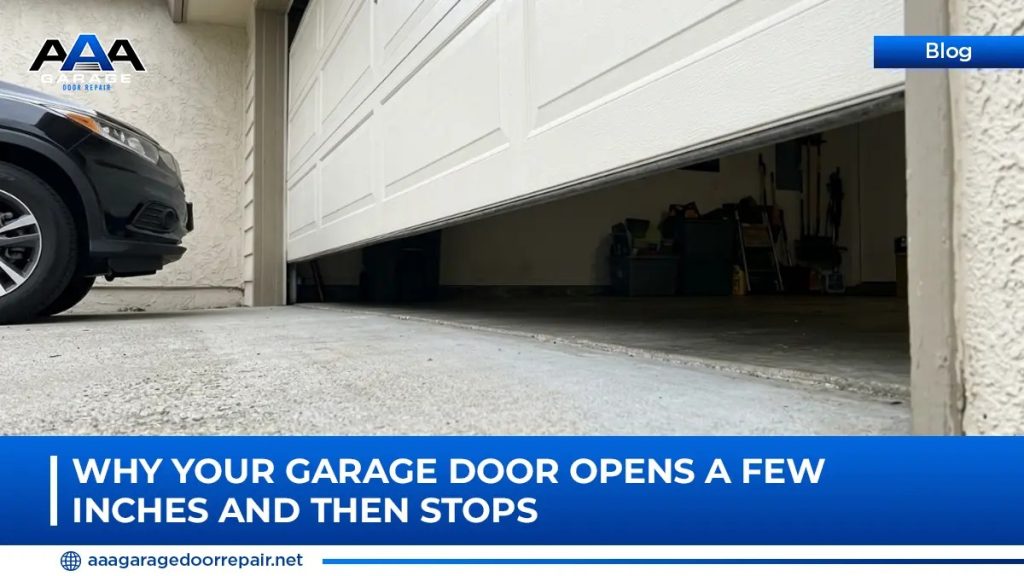
A garage door that starts upward, moves four or six inches, and then stops can be frustrating because the opener appears to be working. The motor may run, the light may come on, and the door may even move slightly—yet it refuses to complete the trip.
That symptom can point to several different problems, including a broken spring, a door that is out of balance, binding rollers or tracks, opener travel issues, or a damaged trolley. The safest approach is to identify whether the door itself is too heavy or obstructed before assuming the motor has failed.
The Most Common Cause: The Door Has Become Too Heavy for the Opener
The opener is designed to move a counterbalanced door, not lift the full weight of the door by itself. If a torsion or extension spring breaks, the opener may pull the door a few inches before its force protection stops the cycle—or before the motor simply cannot move the load farther.
Look from a safe distance for obvious spring damage, such as a visible separation in a torsion spring. Do not touch the spring, cable, bottom bracket, or drum. If the spring system is damaged, schedule AAA spring replacement rather than continuing to test the opener.
Other Reasons a Garage Door May Stop After Moving Only a Short Distance
Your garage door system may also have other underlying issues that require specific solutions.
- A roller is binding in a damaged or shifted track.
- A cable has slipped, frayed, or begun winding incorrectly.
- The door is out of balance and creates excessive resistance.
- The opener trolley, carriage, gear, or drive component is damaged.
- Travel limits or force settings no longer match the way the door moves.
- A hinge or panel has shifted enough to make the door bind during the first part of travel.
- Cold weather has exposed an existing lubrication, alignment, or balance problem.
Because several failures can create almost the same symptom, a full-system inspection is more useful than replacing the opener based on sound alone.
Can You Test the Door Manually?
Manual testing can provide useful information, but only when the door is fully closed, stable, and there is no sign of a broken spring, loose cable, or crooked movement. If the system appears damaged or the door is raised, do not pull the emergency release just to experiment.
When it is safe and the manufacturer’s instructions allow it, disconnecting the opener with the door closed can help show whether the door itself moves smoothly. A properly balanced door should not feel like dead weight. If it is extremely heavy, jerky, or difficult to control, stop the test and arrange professional service.
Why Repeatedly Pressing the Remote Can Make Things Worse
Homeowners often press the button several times hoping the opener will “catch.” That can increase strain on the motor, gears, trolley, rail, and top door section. If the door is binding or a spring has failed, every extra attempt asks the opener to pull against the same unresolved resistance.
The U.S. Consumer Product Safety Commission’s garage door opener safety information emphasizes the importance of functioning entrapment-protection and reversing systems. If an opener is behaving unpredictably, it should be repaired and safety-tested rather than forced through repeated cycles.
When the Problem Is More Likely the Opener
If the door moves freely and remains balanced when safely disconnected, the mechanical door may not be the main problem. The technician can then focus on the opener’s drive system, travel limits, force settings, logic board, receiver, or trolley.
AAA’s garage door opener repair and installation service covers motors, sensors, remotes, limits, drive components, and upgrades. Diagnosing the door first helps avoid replacing an opener when the real problem is mechanical—or replacing mechanical parts when the opener is actually failing.
When the Door Should Be Left Alone
As much as you want to fix your garage door right away, extra caution is needed to avoid further damage. If you notice the issues below, it’s better that you leave your garage door as is and call a professional:
- One side is higher than the other.
- A cable is loose, frayed, or hanging.
- A spring is visibly broken.
- The door makes a sharp popping, grinding, or snapping sound.
- The door is stuck partway open.
- A roller is outside the track.
- The top section bends noticeably when the opener pulls.
These conditions can involve stored spring tension or an unstable door. AAA’s 24/7 emergency service is appropriate when the garage is unsecured, a vehicle is trapped, or the door cannot be left safely in its current position.
How a Technician Narrows Down the Cause
A useful diagnosis starts by watching how the door behaves and then separating mechanical resistance from opener trouble. The technician may check spring condition and balance, cables and drums, rollers and hinges, track alignment, the opener carriage, force and travel settings, and safety functions.
That sequence matters because a garage door is a connected system. A new opener will not fix a broken spring, and a new spring will not fix a stripped trolley. Finding the first failure helps prevent unnecessary parts replacement.
Call AAA When the Door Will Not Open Normally
If your garage door rises only a few inches, do not keep testing it until something finally breaks. AAA Garage Door Repair provides full-system diagnostics across Park Ridge, Chicago, and surrounding communities. Start with garage door repair service or use the contact page to describe exactly what the door does before it stops.
Final Takeaway
A door that opens only a few inches is often telling you that the system is encountering more resistance than it should. Broken springs are a common cause, but tracks, rollers, cables, hinges, opener components, and settings can produce similar behavior. Stop repeated opener attempts, keep clear of unstable hardware, and have the complete system checked so the repair targets the real cause.
Guide did not fix it?